
Opening hours
Monday
Tuesday
Wednesday
Thursday
Friday
Saturday
Sunday
06:00 - 22:00
06:00 - 22:00
06:00 - 22:00
06:00 - 22:00
06:00 - 22:00
06:00 - 22:00
07:00 - 22:00
Subject to change without notice!
Virtual Tours
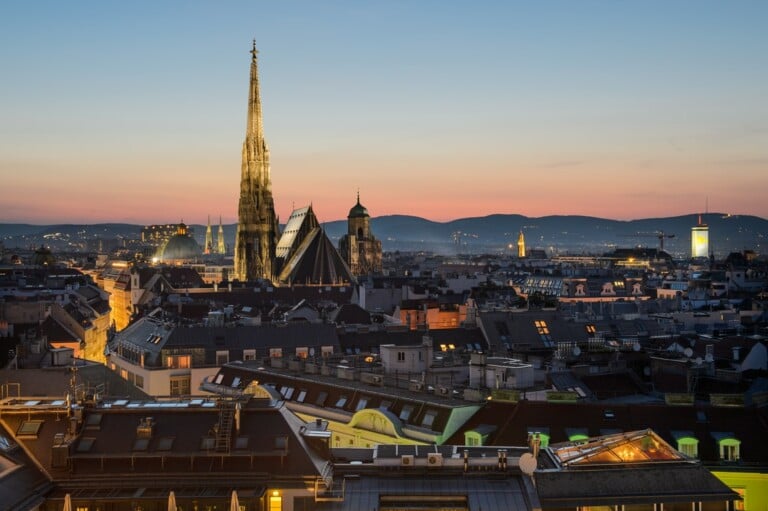

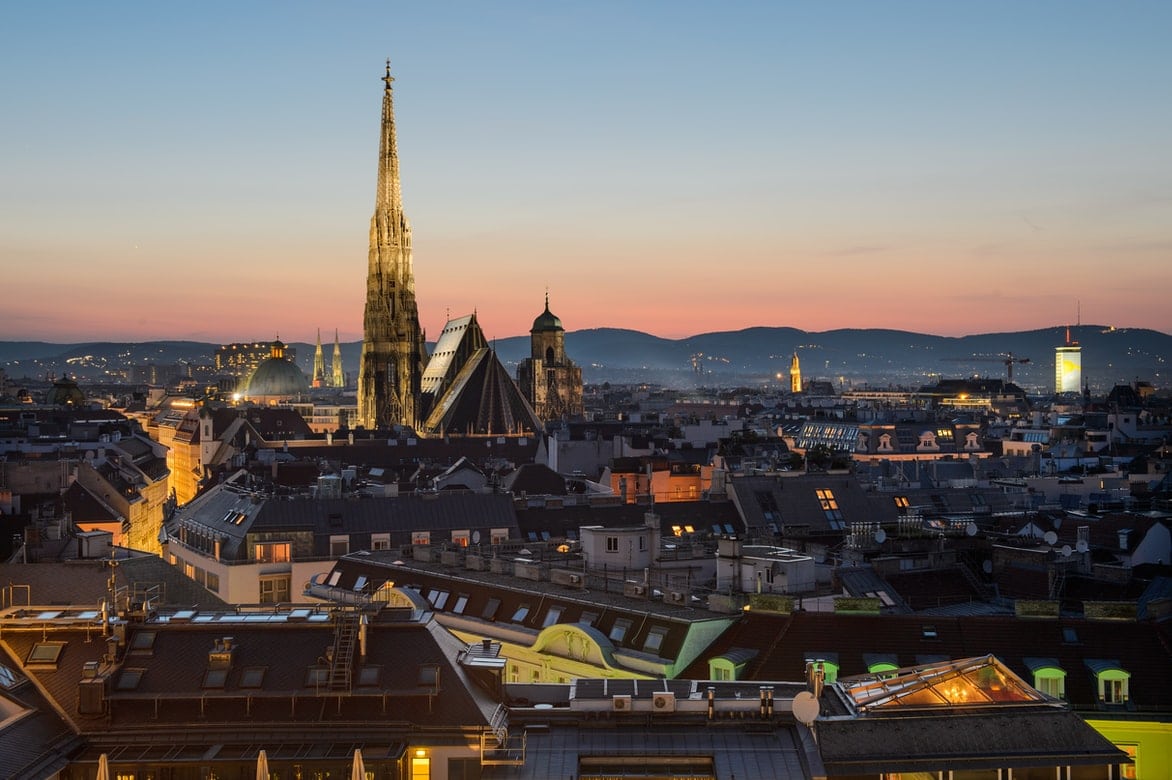
St. Stephen's Cathedral Vienna
First mentioned in a document in 1137, the cathedral is a landmark and the most important Gothic building in Austria.
Vienna's St. Stephen's Cathedral stands for many things: it is a world-famous cultural asset and a building that needs to fear no international comparison. It is THE national landmark of Austria and a symbol of Austrian identity.
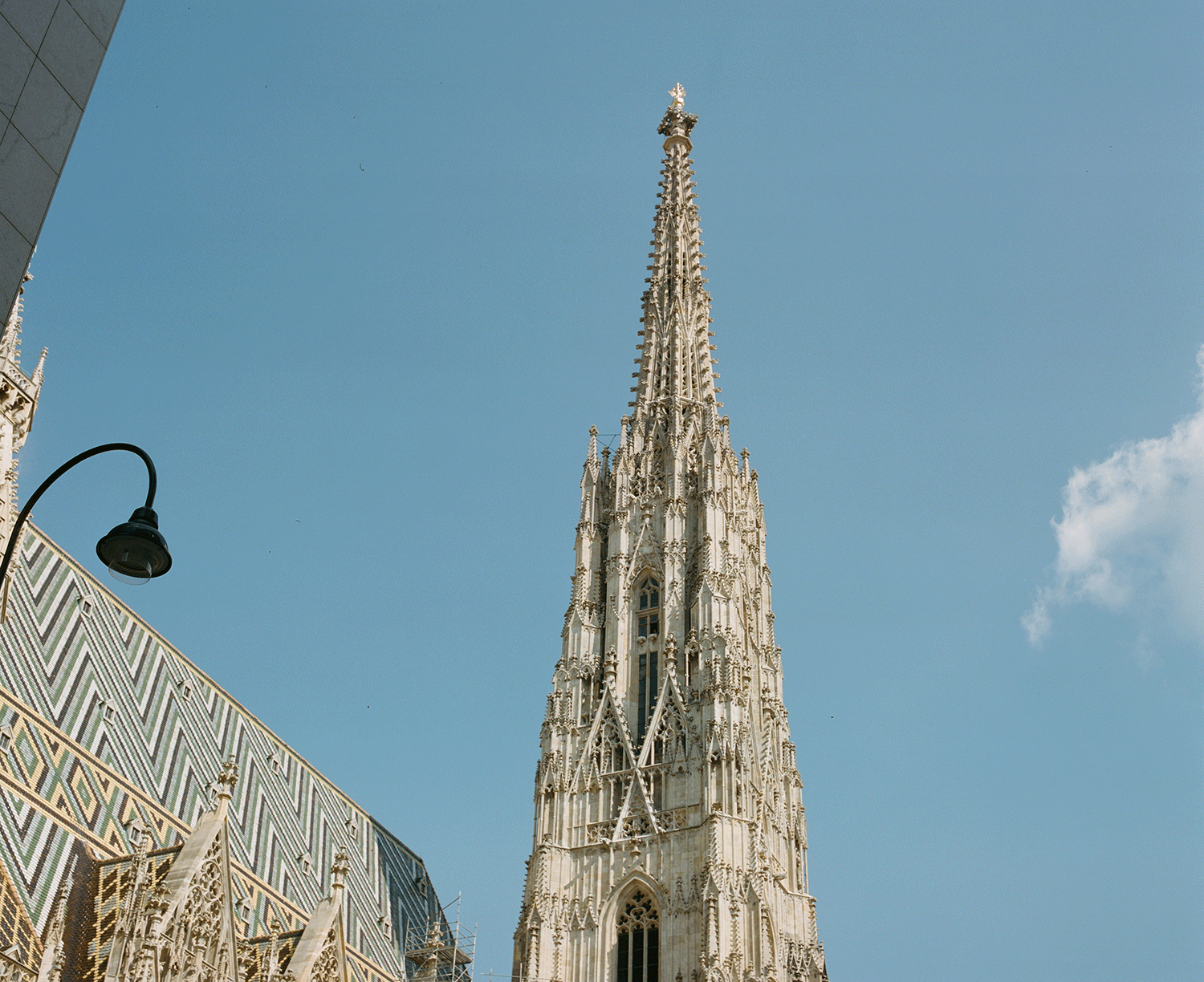
The building is 109 meters long and 72 meters wide. The cathedral is one of the most important Gothic buildings in Austria. Parts of the late Romanesque predecessor building from 1230/40 to 1263 are still preserved and form the west façade, flanked by the two Heidentürme, which are about 65 meters high.
In total, the St. Stephen's Cathedral has four towers: with 136,4 metres, the south tower is the highest, the north tower was not finished and is only 68 metres high.
A total of 13 bells hang in the cathedral. The most famous bell of St. Stephen's Cathedral, the Pummerin, is located in the 68.3 meter high north tower.
It is the second largest free-swinging church bell in Europe.
But above all, St. Stephen's Cathedral, apart from its cultural significance - The Church of St. Stephen: is the spiritual as well as geographical centre of the city of Vienna.
St. Stephen's Cathedral – A Taste of the Virtual Discovery Tour
The Cathedral choirmaster of St. Stephen's
In Vienna's St. Stephen's Cathedral, the Cathedral Kapellmeister directs the Vienna Cathedral Music – one of Austria's most important church music ensembles.
The Vienna Cathedral Music comprises the Vienna Cathedral Choir, the St. Stephen's Vocal Ensemble, the Capella St. Stephen Women's Ensemble, the Cathedral Gregorian Chant Schola, and the Vienna Cathedral Orchestra, supplemented by soloists from the Vienna opera houses and three full-time organists.
Your central task: the musical design of the Sunday Mass – with a repertoire ranging from Gregorian chant to contemporary compositions. At the heart of this is the sacred music of Viennese composers: Joseph Haydn, Wolfgang Amadeus Mozart, and Franz Schubert form the core repertoire, supplemented by works from composers with a direct connection to St. Stephen's Cathedral Vienna, such as Michael Haydn, Johann Georg Albrechtsberger, and Johann Joseph Fux.
This is how the Genius Loci of St. Stephen's Cathedral becomes audible – for an international, diverse audience touched by the universal language of music.
The tomb of Emperor Frederick III in St. Stephen's Cathedral, Vienna
The tomb of Emperor Frederick III is considered one of the most important tomb monuments in Europe. Frederick III, who reigned for almost the entire 15th century and was the last emperor to be crowned by the Pope in Rome, commissioned the famous Dutch sculptor Niclas Gerhaert van Leyden to design his tomb.
The completion only took place many years after the emperor's death. The monument impresses with its extraordinary wealth of detail: coats of arms of the Habsburg territories, depictions of imperial foundations, figures of the electors, and numerous animals as symbolic protective and guardian figures adorn the tomb.
It was made from red Salzburg marble, a particularly high-quality but delicate crystalline rock. The lid of the sarcophagus was crafted from a single block of stone – an exceptional feat of craftsmanship. To protect the delicate original, it is not freely accessible.
On the west gallery of St. Stephen's Cathedral, however, there is a precise 1:1 laser copy that visitors can examine up close – including the top of the gravestone, which is not visible on the original.
The Pummerin and the New Year's chimes
The ringing of the Pummerin to mark the New Year is an impressive symbol of the special significance of St. Stephen's Cathedral for the people of Vienna and Austria.
The Pummerin, the country's largest bell and dedicated to the Mother of God Mary, traditionally rings in the new year. This tradition is almost unique in Europe: Even before the Blue Danube Waltz sounds, the solemn ringing of the Pummerin ushers in the turn of the year.
For generations, this moment has been inextricably linked with the start of the year for many people and, far beyond its religious context, is a firm part of Austrian identity.
The Pummerin thus represents not only a centuries-old tradition but also the close emotional bond between people and St. Stephen's Cathedral.
The current music area of St. Stephen's Cathedral has only been located in the immediate vicinity of Emperor Frederick III's high tomb for a few decades. Previously, the cathedral music was housed for centuries on galleries in the west of the cathedral – far from the chancel.
The new spatial proximity reflects a changed understanding of church music. Since the mid-20th century, it has no longer been regarded as mere musical embellishment of the service, but rather as an integral part of it.
The close connection between the altar, the proclamation, the congregation, and the musicians makes this understanding immediately tangible in St. Stephen's Cathedral.
For concerts, a dedicated choir podium will be erected in the centre of the cathedral, allowing for optimal sound projection throughout the entire church. During services, the choir and instrumental ensembles will perform in the side music area, where the 1991 choir organ and the choir podium built in 2014 are located.
The church music at St. Stephen's Cathedral is considered part of the liturgy. It accompanies prayer, invites singing along, and creates a space where music can touch people and help shape the service in a special way.
The choir organ plays a central role, musically supporting both the liturgy and performances of the Vienna Cathedral Music with choirs and the Cathedral Orchestra.
The Pilgram Pulpit is considered one of the most significant sculptural works of the Late Gothic period. To this day, it is predominantly attributed to the cathedral master builder Anton Pilgram and impresses with its exceptional craftsmanship and artistic quality.
The upper part of the pulpit was crafted from a single block of stone. Also famous is the sculptor's self-portrait, which is located on the pulpit – one of the earliest artist portraits of its kind.
A special feature of the pulpit and of St. Stephen's Cathedral as a whole is medieval number symbolism. The numbers 3, 4, and 7 play a central role: three stands for the divine and the Holy Trinity, while four symbolises the earthly world. Together, they make seven – the number of perfection and completeness. This symbolism can be found in the tracery of the pulpit, as well as in the design of the windows and the proportions of the structure.
The architecture of St. Stephen's Cathedral also follows a well-thought-out numerical concept. The medieval system of measurement is based on the fundamental number 37: each nave is 37 feet wide, and the total length of the cathedral is also a multiple of this number. The 37 connects the symbolic numbers 3 and 7 and also possesses mathematical peculiarities. For example, 37 × 3 = 111 – a further reference to the Holy Trinity.
The connection of architecture, mathematics, and Christian symbolism clearly shows how closely art, faith, and science were intertwined in the Middle Ages. St. Stephen's Cathedral is one of the most impressive examples of this.
A central focal point in the cathedral is the so-called rood screen cross. Its name derives from the historical „Lettner“ (rood screen), a separating structure that, until around 1500, demarcated the altar area from the rest of the church.
This structure did not fully separate, but was opened by arcades and also allowed preaching and passage in the upper area.
The rood screen itself was removed around 500 years ago, but the rood screen cross was preserved as a significant liturgical symbol. The magnificent, formerly gold-decorated cross was severely damaged in the fire at St. Stephen's Cathedral in 1945. Of the original wooden sculpture, only the head and the arms with the forearms were preserved; other parts could be partially saved or documented.
After the war, the cross was supplemented and reconstructed, based on historical templates and existing copies. For several decades, it was located in the northern area of the cathedral near a memorial site, before being moved back to a central position in the church space.
Today, the rood screen cross again hangs prominently in the cathedral space and is visible as a floating, space-defining symbol of St. Stephen's Cathedral.
With a total of 22 bells, St. Stephen's Cathedral has Austria's largest peal of bells, and is also one of Europe's most important bell ensembles. While the Pummerin, as the country's largest bell and the „voice of Austria“, is widely known, a special treasure is hidden in the northern Heathen Tower of the west façade.
There is the historic bell chamber with seven medieval bells. The oldest of them, the Chorglöckl, dates from the 13th century, as do parts of the roof structure and the tower walls, and is among the oldest still-used bells in Austria.
The ringing of the bells remains an integral part of life at St. Stephen's Cathedral to this day. It accompanies divine services, calls to prayer, announces church festivals, and also rings out for special occasions or times of remembrance. Unlike museum objects, the historical bells are still regularly in use today and, with their characteristic sound, shape the soundscape of Vienna's city centre.
For centuries, bells dictated the rhythm of urban life. For instance, the fire bell warned of blazes, while the so-called „Bieringerin“ announced the closing time of Viennese inns daily. In the South Tower – the "Steffl" – tower bells have also struck the hours since the 15th century, connecting generations of Viennese people with St. Stephen's Cathedral to this day.
The bells of St. Stephen's Cathedral are therefore far more than historic sound bodies: they are living cultural heritage and a symbol of the history, faith and life of the city of Vienna that can still be heard today.
Gothic architecture is often referred to as the „architecture of light“. In contrast to Romanesque architecture, with its massive walls and small windows, new building techniques enabled larger window surfaces and light-filled church interiors. Light became an essential design element and shaped the spiritual impact of the architecture.
Light plays a central role in St. Stephen's Cathedral as well. The church building is oriented so that the morning light reaches the altar, and different lighting moods unfold in the space over the course of the day. The windows on either side of the high altar are still preserved from the medieval stained-glass windows. They give an impression of how the entire cathedral must have originally appeared.
The medieval windows in the nave were already replaced in the Baroque period. This significantly altered the character of the interior. Whereas previously a mysterious, darker atmosphere was deliberately created – historical sources even report the use of soot for darkening the vaults – today, a bright and transparent spatial effect is paramount.
The windows installed after the Second World War allow significantly more daylight into the cathedral. This makes the stone sculptures, altars, and architectural details stand out more clearly. The natural light is complemented by a modern lighting system, which effectively highlights the interior of the church depending on the occasion and has won awards for its outstanding design.
St. Stephen's Cathedral impressively demonstrates how the use of light has changed over the centuries – and how architecture, glass, and lighting together shape the special atmosphere of the church interior.
Weather forecast Stephansdom Wien
Select date
morning

19 °C
at noon
20 °C
evening

18 °C
morning

19 °C
at noon
20 °C
evening

20 °C
morning

21 °C
at noon
24 °C
evening

21 °C
Arrival
The best way to get to the very centrally located Vienna Stephansdom is by underground. Since in Vienna the public transport is very well developed, it is possible that St. Stephen's Cathedral is very easy to reach with the U1 and the U3.
